Seven Conversations Between Spin Cycles: A Saturday at the Laundromat
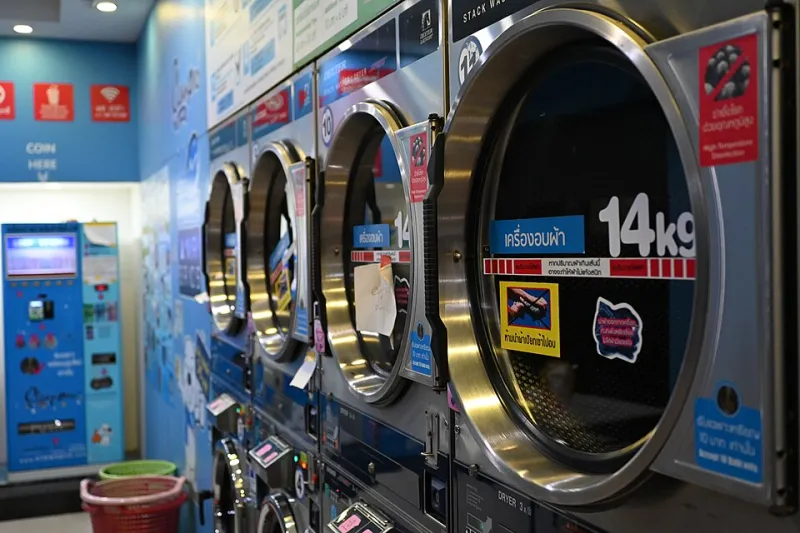
Photo: PattayaPatrol, CC BY-SA 4.0, via Wikimedia Commons
On a Saturday in November, I took a roll of quarters and a notebook to a laundromat in a New Jersey strip mall. I told myself I was there to do laundry. Really I was there to listen. A laundromat is not a waiting room. It is a theater with a spin cycle. People come in with their public solitude, their baskets, their half-finished phone calls, and for an hour or so they belong to the same small, steamy country.
The machines hum. The change dispenser clangs. Someone always forgets a dryer sheet. Someone always asks if you are done with the washer with the sticky door. The conversations are not performances. They are fragments, the kind of talk that happens when people have nowhere else to be. Over one Saturday, I heard seven lines that stayed with me. Here they are, with the small lives they revealed.
1. 'If your father calls, tell him the dryer ate his good shirt.'
A woman in a puffer vest was folding a mountain of children's clothes while her son, maybe eight, spun on a plastic chair. She said the line into her phone, then listened, then laughed. 'No, I'm not covering for you. I'm just telling you what the dryer did.' The boy looked up and said, 'Did the dryer really eat it?' She said, 'The dryer is a metaphor, baby.' He went back to spinning. She went back to folding. The whole exchange took twelve seconds and contained an entire marriage.
2. 'You don't have to stay for the rinse. I'll text you.'
Two roommates in their twenties were splitting a load. One had a date. The other had a paper due. They negotiated the handoff like diplomats, holding up a phone to show the cycle timer. The one with the date kept saying she could wait. The one with the paper kept saying she should go. Neither moved. Finally the paper one said the line, and the date one hugged her and left. Then the paper one sat down and watched the machine like it was a campfire.
3. 'I'm not saying she's a bad person. I'm saying she folds like she's mad at the towel.'
Two older women were working side by side at the long folding table. They had matching carts and nonmatching opinions. One was describing a mutual friend's laundry habits as if they were a moral failing. The other kept saying, 'Mm-hm,' in a way that meant she agreed but would never say so out loud. They folded sheets together with the ease of people who had been folding sheets together for decades. The insult was not cruel. It was a kind of intimacy.
4. 'Sir, is this your sock? It has a duck on it.'
A girl of about ten held up a small yellow sock with a cartoon duck near the toe. She asked every person in the aisle. A man in a hoodie said no. A woman with earbuds pretended not to hear. A man at the vending machine said, 'I wish.' The girl eventually put the sock on the lost-and-found shelf, next to a single glove and a paperback novel with a cracked spine. She did it carefully, like a librarian shelving a rare book. Somebody, somewhere, was missing that duck.
5. 'They raised the price by a quarter. A quarter! In this economy.'
A man at the change machine was not really talking to anyone. He was talking to the machine, or the room, or the year itself. A woman nearby said, 'Everything goes up but the dryer time.' He nodded like she had solved a riddle. 'That's the truth,' he said. 'That's the whole truth.' They stood there for a moment, two strangers agreeing about a quarter, which is sometimes all it takes.
6. 'You can use my dryer sheet. I bought the big box.'
A woman with a laundry basket on her hip offered a sheet to a younger man who was staring at the vending machine like it had personally failed him. He said he was fine. She said, 'Honey, nobody is fine without a dryer sheet.' He took it. She went back to her folding. It was a small kindness, the kind that does not get thanked properly because it happens too fast. The man used the sheet. His clothes came out smelling like a stranger's generosity.
7. 'My mom used to bring me here. She'd talk to everybody. Drove me nuts.'
A young woman said this to her friend while they waited for the last load. She was looking at the row of washers, not at anyone in particular. 'She knew everybody's name. Everybody's.' Her friend said, 'Do you talk to everybody now?' The young woman laughed. 'No. I'm here with my headphones and my dignity.' Then she took one earbud out. She did not talk to anybody. But she left it out.
The Theater of Public Solitude
None of these lines would matter anywhere else. They are not quotes. They are residue. But a laundromat is one of the few places in America where public solitude is allowed. You are alone, but you are not private. You are in a room with other people who are also waiting, also folding, also trying to get through the day. The conversation is not the point. The proximity is.
I left with clean clothes and a notebook full of other people's sentences. I did not feel like a spy. I felt like a neighbor. The dryers were still going. Someone was still asking about the sticky door. The theater had another show.