The Lobby Wall Remembers: Fading Headshots and the Long Life of Local Fame
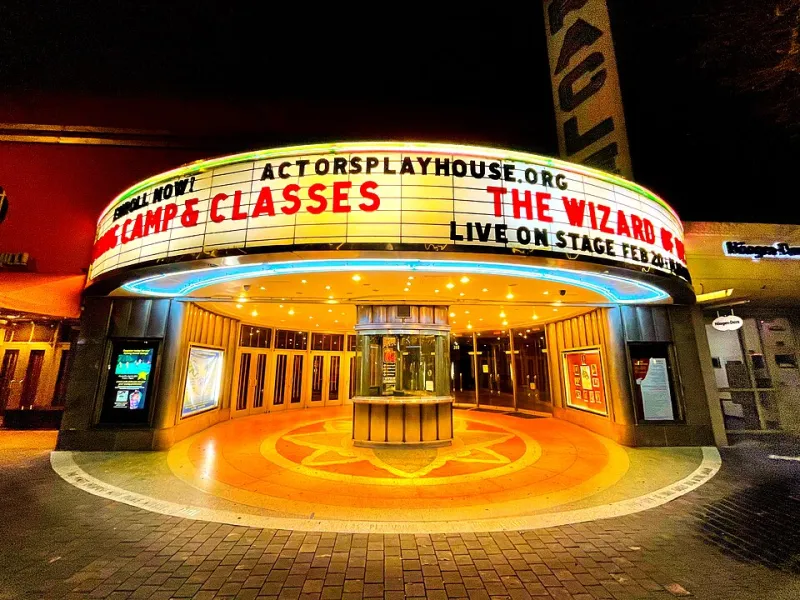
Photo: Rob Olivera, CC BY 2.0, via Wikimedia Commons
The wall is directly across from the concession stand, where the coffee is always a little burnt and the candy is always a little stale. It is a corkboard, technically, but nobody calls it that. People call it the wall. It holds maybe two hundred headshots, some in color, some in black and white, some curling at the corners like leaves in late October. They are arranged without much logic: a whole season here, a single production there, a face from 1987 wedged between a face from 2019 and a face from last spring.
I grew up in this town. I have walked past this wall a hundred times. I have never seen it the way I saw it this November, standing in the lobby before a Sunday matinee, waiting for the house to open. The coffee was burnt. The candy was stale. The wall was full of people.
The Corkboard as a Town Register
A community theater is not a museum. It is a working building. The lobby smells like old carpet and new paint. The bathroom door sticks. The box office window has a sign taped to it that says no refunds in a font that has not changed since the 1990s. But the wall is something else. It is a register of people who showed up.
Some of the faces are professional headshots, the kind with a soft-focus background and a serious jaw. Most are not. They are cropped snapshots from someone's camera, printed at the drugstore, stapled to the cork. A man in a fake mustache. A woman in a bonnet. A teenager in a leather jacket looking like he cannot believe he agreed to this. A stagehand who is not acting at all, just standing in the wings, caught in the flash.
Local fame is a strange thing. It is not the same as being known. In a small town, you can be famous for playing Tevye in 1998 and also famous for working at the hardware store. The wall does not distinguish. It gives everyone the same rectangle. The same staple. The same slow fade.
What Fading Paper Knows About Time
There is a woman on the wall named Dolores. She played Mrs. Webb in Our Town in 1987. In the photo, she is young, with dark hair and a smile that looks like it is trying not to be too pleased with itself. I know her now as the woman who runs the church rummage sale. She has white hair and a bad hip and a laugh that carries across a parking lot. The wall remembers the girl. The town knows the woman. Both are true.
This is what a photo wall does that a Facebook page cannot. It ages in public. The paper yellows. The colors go strange. The staples rust. A face from twenty years ago becomes a small archaeological site. You can see the light in the room where the photo was taken, the fashion, the haircut, the particular way someone held their chin because they were nervous. You can see the hope. That is the part that gets me. Everyone in those photos is hoping, at least a little, to be seen.
A town needs a place where ordinary people are still recognized long after the curtain falls. Not because they were brilliant. Because they were there. Because they stood on a stage in a borrowed costume and said lines they had practiced in the car. Because they built a set with a chop saw and a bad ruler. Because they sold tickets, ushed, cleaned the bathroom, ran the light board. The wall does not rank them. It just keeps them.
The Curtain Falls, the Face Stays
In 2026, fame is a metric. It is followers, streams, engagement, the relentless arithmetic of being seen. Local fame is not a metric. It is a memory. It is the guy at the diner who says, 'Hey, weren't you in The Music Man?' It is the woman at the library who remembers your mother played the piano for Annie. It is the kid who watches you in a show and decides, for the first time, that maybe he could do that too.
Community theater is one of the last places in America where you can be recognized for something you did for free. That is not a small thing. It is a counterweight. It says that a life can be measured in more than productivity. It says that a town can hold a person's face without needing to monetize it.
This November, the theater is staging a holiday show. The lobby is full of new faces. There is a woman with a clipboard. A man in a Santa hat. A teenager running lines in the corner. The wall is watching them. In a few months, their photos will go up. They will be stapled next to Dolores. They will start to fade. Someone will walk past in 2046 and see them the way I saw Dolores. Someone will ask, 'Who was that?' And someone else will say, 'Oh, she was in Our Town. She was wonderful.'
The curtain falls. The face stays. That is the whole promise of the wall.