Sixty-Four Colors of Honesty: What My Niece Draws That Our Cameras Never Catch
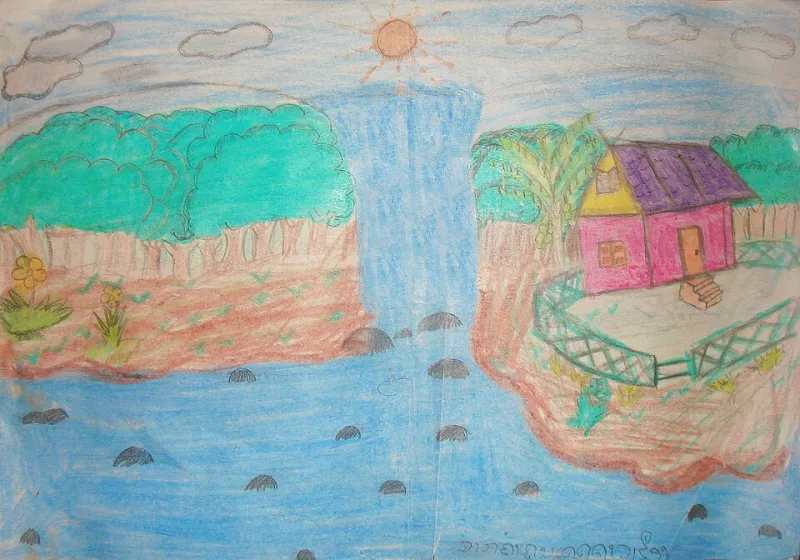
Photo: Khamkhoune at 11 years old (contact Basile Morin), CC BY-SA 4.0, via Wikimedia Commons
There's a coffee table in my sister's house in Columbus that has become, unofficially, a gallery. On it: a growing stack of crayon portraits by my niece, Delia, age eight, rendered on printer paper and held down with a ceramic pumpkin that has no business being out in June.
The family has mixed feelings about the gallery.
The Portrait That Ended the Cookout
It started innocently. At Memorial Day, Delia handed her grandmother a drawing: Grandmom at the stove, holding a spatula, with an enormous red heart coming out of her chest and landing on a plate of pierogi. Everyone laughed. Grandmom cried a little. It was the good kind of crying, the kind you frame.
Then, at the Fourth of July party, Delia handed Uncle Rick his portrait. In it, Rick stood slightly apart from the rest of the family — a good six inches of white space between him and everybody else — drawn entirely in gray.
Nobody laughed.
Rick and my sister haven't really spoken since the Christmas of 2019, something about a loan and a text message that got screenshotted. The adults have all mastered the choreography of pretending: the nods across the yard, the too-long conversations about the Browns. Delia, holding her box of 64 colors (the good kind, with the sharpener in the back), had simply not learned the choreography yet.
She drew the truth. The truth was gray, and it stood alone.
Children Draw What Grown-Ups Manage
Here's what I've come to understand watching Delia work: a photograph captures what a face does for a half-second. A child's drawing captures what a face does all the time.
Photograph my mother and she'll do the thing where she lifts her chin and half-smiles, the expression she's worn in every school picture, wedding, and DMV visit since 1974. But Delia's portrait of Grandma Jo shows her with her shoulders drawn sloping down and a small blue scribble over her chest. When I asked what the blue was, Delia said, "That's her sad. She keeps it high up so it doesn't fall out."
Grandpa Walt died in March. Nobody had used the word grief in front of Delia. Nobody had to.
This is the thing about kids before they learn politeness — and politeness is a real skill, I want to be clear, a necessary one. But before the training kicks in, they draw the aunt's anger that leaks out only at Thanksgiving, the cousin's smile that never quite involves the eyes, the grandfather who is physically present and otherwise somewhere else. They draw with their whole attention, and their whole attention has no filter.
The Family Review Board
Not everyone has been a fan. Delia's father — my brother-in-law — was rendered with what she called "his thinking cloud," a dark scribble permanently attached above his head. He laughed it off at the time, then I caught him later on the back porch, staring at his phone, presumably at a picture of the drawing my sister had posted in the family group chat.
The group chat is its own ecosystem now. Every new portrait gets analyzed like a Zapruder film. Why am I holding a magnifying glass? Why is Deb drawn smaller than her actual dog? My cousin Deb's dog is, in fact, drawn larger than Deb. When asked, Delia shrugged and said, "He takes up more room."
Deb has requested a redo. Delia does not do redos.
And honestly, I respect that. Somewhere between eight and adulthood, we all become a committee of revisions — softening the gray, shrinking the magnifying glass, adding smiles we don't feel. Delia's studio operates on a first-draft-only policy, and the first draft is the true one.
What We Do With the Truth
Here's the part I didn't expect: the drawings have started doing something the family couldn't do for itself.
After the gray portrait of Uncle Rick made its rounds, my sister called him. Not a text. A call. They talked for forty minutes, and while nothing is fixed — nothing is ever fixed, it's family — he came to the pool party in August. Delia's newest portrait of him has a little yellow in it. She said the yellow was because he brought her a pool noodle.
It's not forgiveness, exactly. It's a color change.
I keep thinking about that box of 64 colors, the one with the sharpener built into the back. Every one of us started with the same box, in some form. We all drew people honestly once — big heads, no necks, feelings rendered as weather. Then someone laughed at a drawing, or asked why we made Grandma look sad, and we started editing. We learned which colors were safe. We learned to draw the family the way the family prefers to be seen.
Delia hasn't learned that yet. Maybe she never will, though I doubt it — the world is patient and thorough. But for now, her coffee table gallery holds us all accountable, one crayon portrait at a time.
Last week she drew me. In it, I'm standing in the kitchen, and coming out of my chest is a long orange line that connects to everyone else in the drawing, even Uncle Rick, even the dog.
"What's the orange?" I asked.
She looked at me like the question was strange. "That's you," she said. "You're the one who asks everybody the questions."
I have never been captured more accurately in my life. I did not ask for a redo.