Thirty Minutes of Being Looked At: My Portrait Sitting in Washington Square
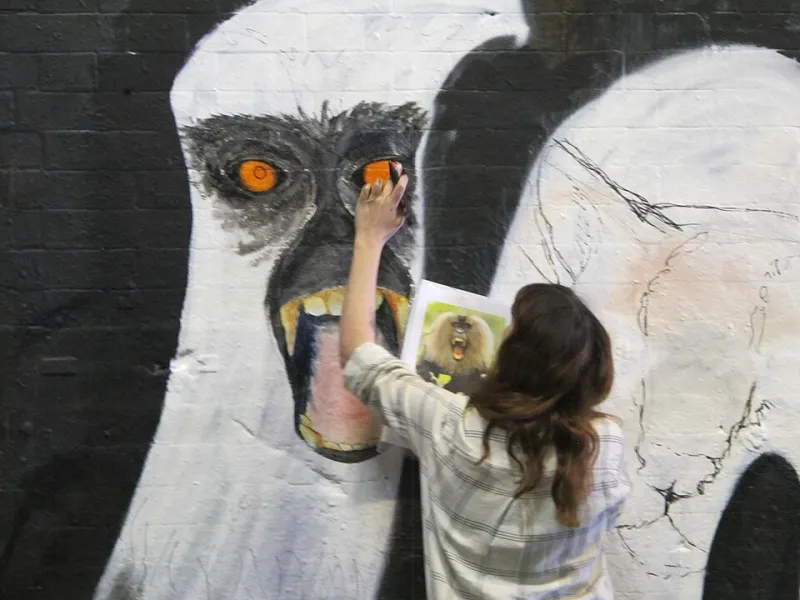
Photo: maggie jones., Public domain, via Wikimedia Commons
There's a row of portrait artists along the fountain plaza in Washington Square Park, easels tilted toward the sky like sunflowers, and I have walked past them maybe two hundred times without stopping. This spring, on a Saturday with nothing on my calendar, I stopped.
The artist who waved me over was a woman in her sixties named Marisol, working in charcoal, twenty dollars for twenty minutes — a price that seemed almost rude to negotiate. She pointed at a folding stool. I sat. And for the next half hour, a complete stranger studied my face with an intensity that no one — not a partner, not a parent, not a doctor — had ever directed at me before.
I want to talk about what that feels like. But first, a detour.
The Oldest Street Job in New York
Street portraiture is practically an archaeological layer of the city. Washington Square, Central Park, the old South Street Seaport — for over a century, artists have set up where foot traffic slows and egos are willing. The tradition survived photography, which was supposed to kill it, and it survived Instagram, which was also supposed to kill it.
Marisol has been at her spot for eleven years. Before that, she drew portraits in a plaza in Bogotá. She estimates she's done "thousands — maybe ten thousand" faces. When I asked her which ones she remembers, she didn't hesitate.
"Not the beautiful ones," she said, not looking up from the page. "I remember the ones who couldn't hold still. The man who cried and pretended he had something in his eye. The teenager who asked me to draw her prettier, and I told her no."
She told me no. I wanted to applaud.
What People Reveal When They Sit Still
Here's what I learned from Marisol, and later from Dante, a younger artist two easels down who works in ink: people cannot hide for thirty minutes.
"The first five minutes, everyone performs," Dante told me. "They give me their license-photo face. But the face gets tired. Around minute ten, the real one shows up. That's the one I draw."
He says he can tell within minutes whether someone is going through something. Not from anything they say — they usually say nothing — but from where the tension lives. Clenched jaw. A forehead that won't smooth. Shoulders up around the ears. "People think a portrait is about what you look like," he said. "It's about what you're holding."
When I asked what he does with that information — the sadness he can clearly read on strangers' faces — he shrugged. "I try to draw them with dignity. That's all anybody wants anyway."
The Unnerving Experience of Being Seen
Now, back to my stool.
The first few minutes were genuinely uncomfortable. Every instinct I've built over twenty years of video calls and front-facing cameras was screaming at me. We are all, in the filter age, experts at our own image and strangers to our own faces. I know exactly which angle I look best from. I did not know what my face does when it's just existing, unposed, watched.
Marisol kept glancing up — a quick flick of the eyes, then back to the paper, over and over, hundreds of times. Each glance felt like a small x-ray. At one point she said, "Relax the mouth," and I realized I had been unconsciously managing my own expression, the way we all do now, always.
Somewhere around minute fifteen, something shifted. I stopped performing. My face got tired, like Dante said it would, and whatever was underneath came out. I don't know what that was. But when she turned the finished portrait around, I saw a face that looked more like me than any selfie I've ever taken — older, more tired, and somehow more honest.
Why We Still Pay Strangers to Draw Us
A phone can capture your likeness in a millisecond, for free, endlessly. So why does a line still form at these easels every weekend?
Because the drawing isn't really the product. The product is the thirty minutes. It's the rare modern experience of being looked at slowly, by someone with no incentive to flatter you and no algorithm deciding what you should see of yourself. It's attention — the old-fashioned, undivided kind — pointed directly at you.
Marisol put it better than I could. "People don't come for art," she said, wiping charcoal off her fingers. "They come because nobody looks at them anymore. Not really. I look. That's the whole business."
I walked out of the park with a rolled-up piece of paper and a slightly rearranged sense of myself. The portrait now hangs in my hallway, and visitors always ask where I got it. I tell them the truth: a stranger looked at me for half an hour, and I finally let her.