Wrong Cousin, Right Friend: The Case of the Mistaken Hello in Toledo
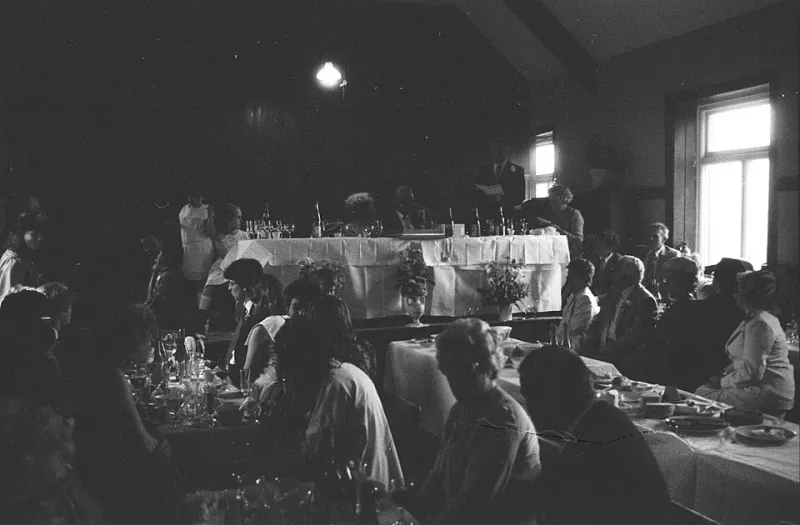
Photo: Geoff Charles, CC BY-SA 4.0, via Wikimedia Commons
There's a specific kind of panic that sets in about forty minutes into an out-of-town wedding reception, when you realize you know exactly four people in the room and one of them is the bride, who is currently very busy. It was somewhere in that window — somewhere between the shrimp cocktail and the second time the DJ played "Shut Up and Dance" — that I walked up to a woman by the dessert table in Toledo, Ohio, and said, with total confidence, "Dana! Oh my god, Dana!"
She was not Dana.
She was, as I would learn roughly four seconds too late, a childhood friend of the groom's mother. Her name was Carol. And instead of letting me do the thing I desperately wanted to do — fake a phone call, retreat to the bathroom, leave the state — she laughed, pointed at my name tag (why was I wearing a name tag? grief, probably), and said, "Well, now you have to tell me who Dana is and why she owes me a drink."
We closed down the reception. That was eleven years ago.
The Duty We Feel Toward Other People's Faces
I've thought a lot about why I said "Dana" at all. I'd met Dana exactly twice. But there's a strange pressure at these gatherings — weddings, reunions, the christening of a baby whose parents you can't quite place — to perform recognition. To walk into a ballroom in a hotel banquet wing and act like the faces floating past you are familiar.
I think it's a form of politeness weaponized by anxiety. We'd rather risk being wrong than stand alone by the gift table holding a warm Sprite. So we squint at strangers and think, Do I know you from work? From college? From the DMV line in 2014? And sometimes the squinting becomes a greeting, and the greeting becomes a mistake.
There's also something about faces specifically. A voice on the phone you can ask to repeat itself. A name you can blame on a bad connection. But a face — a face feels like evidence. Surely I've seen you before. Surely that means something. Weddings gather a hundred people who share nothing but proximity to the couple, and our brains, desperate for order, start inventing connections between them.
What Carol Taught Me
Here's what I didn't expect: the mistake was the best icebreaker I've ever stumbled into. Because being confidently wrong about someone is instantly humanizing. There's no small talk to climb through — no "so how do you know the couple," no weather. Carol and I started with me apologizing and her roasting me for it, and everything after that was easy.
She came to my wedding six years later. She sends my kids birthday cards. My actual cousin's college roommate, the real Dana, has never once appeared in my life. The universe made an editorial decision and I've learned not to question it.
A Field Guide to the Wrong-Name Hello
Since then, I've both committed and witnessed dozens of these mistakes, and I've developed something of a protocol. Consider it a public service:
1. Commit to the apology, not the excuse. "I'm so sorry, I mixed you up with someone" lands fine. "Well, you look JUST like her" lands like an insult wrapped in a compliment. Take the L cleanly.
2. Let them have the joke. Most people find mistaken identity genuinely funny — it's one of the few social stumbles where the other person holds all the power and usually chooses kindness. Give them room to enjoy it.
3. Turn the error into a question. "Who DO you know here?" is a better conversation starter than any scripted icebreaker, because the answer is always a story.
4. Never fake the recovery. The worst move is pretending you meant to say their name. Nobody believes you. Carol would agree.
5. If it's truly mortifying, name it later. A follow-up text the next day — "still thinking about calling you Dana, anyway, great to meet you" — converts embarrassment into charm.
Say It Anyway
I still get the urge at every wedding. Some cousin's fiancé, some uncle's new wife, some face that my brain insists it has catalogued somewhere. And I've mostly stopped suppressing it — not because I enjoy being wrong, but because I've learned what the urge actually is. It's not really about recognition. It's a bid for connection wearing the costume of recognition.
Sometimes the face really is familiar. Sometimes it isn't, and you say "Dana" to a Carol, and a decade of friendship starts at the dessert table. Either way, the risk is small and the alternative — standing alone, squinting, holding a warm Sprite — is worse.
So yes. You look familiar. You might not be. Say hello anyway.