The Stranger in My Rearview Mirror: A Parking Lot, a Glance, and the Face I Didn't Recognize
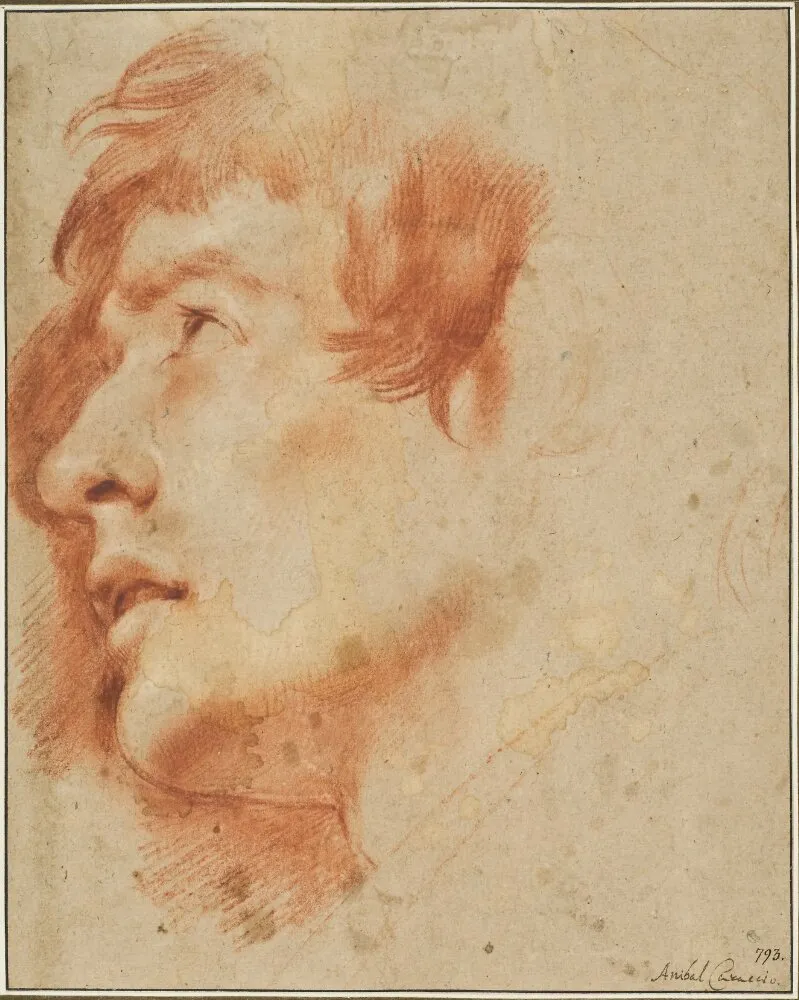
Photo: Agostino Carracci, Public domain, via Wikimedia Commons
It happened on a Tuesday, in a Walmart parking lot in suburban Ohio, between a cart return and a minivan with a cracked taillight. I had just buckled my seatbelt, glanced up out of habit, and there — in the rearview mirror — was a man looking back at me. Gray at the temples. Tired around the mouth. Squinting slightly, the way my father squints.
I did not know him.
Not immediately. Not for a second, maybe two, maybe three — an eternity in the economy of recognition, where we usually identify a face in under 200 milliseconds. Then something clicked, the way a name clicks when it's been sitting on the tip of your tongue, and I understood: that's me. That's the face I've been wearing.
I sat in the parking lot longer than I needed to, engine idling, thinking about what those three seconds meant.
The Face We Carry vs. The Face We Wear
There's a word I grew up hearing — chehra. In Urdu and Hindi, it means face, but it carries more weight than that. It's the face you present, the countenance, the version of you that the world gets to see. My grandmother used it almost like a reputation: apna chehra sambhalo — mind your face, keep your bearing.
Here's the thing nobody tells you: the chehra drifts. The face inside — the one assembled somewhere around age eighteen, the one that still feels like the default setting — stays put. The face outside keeps moving without consulting you. Gray creeps in. Lines set up permanent residence around your eyes. Your jaw settles into the shape of every worry you've swallowed.
Psychologists have a name for the extreme version of what I felt: prosopagnosia, or face blindness, a condition where people genuinely cannot recognize faces, sometimes even their own reflection. True prosopagnosia affects an estimated 2% of the population. But researchers also talk about the other-race effect, the own-age bias — the strange fact that we're measurably worse at recognizing faces that don't match the categories we're used to. Apparently, my own face had drifted out of the category I was fluent in. I had become, to myself, a stranger of a different age.
Three Seconds of Anonymity
What struck me most wasn't the mismatch. It was the judgment my brain rendered in those three seconds before the click: neutral. Harmless. Someone's dad, probably.
I was assessing myself the way I assess strangers — quickly, ungenerously, on vibes alone. And the verdict was mild. Forgettable. A man in a Honda.
I wonder now if that's the real gift hiding inside the disorientation. We spend decades unable to see our own faces objectively; the mirror is a funhouse of familiarity. But for three seconds in that parking lot, I got the stranger's view. I got to meet myself the way a new acquaintance would — without the twenty-five years of context, without the inside jokes, without the memory of who I was at twenty-two.
And honestly? He seemed like decent company.
The Versions We've Outgrown
After that day, I started paying attention to the other faces I carry around. The version of me at every job interview I've ever botched. The version from my wedding, squinting into the sun. The one from my mother's hospital room, which I haven't revisited in years and may never.
The self-recognition literature calls the mirror self a body-centered identification — we know it's us because the reflection moves when we move. But nobody has a good explanation for the emotional lag, the gap between seeing a face and claiming it. Maybe that gap widens with every decade because we keep revising the tenant while the landlord inside never updates the lease.
My grandmother, for what it's worth, had a theory. She said you should check your chehra the way a farmer checks the sky — not to change it, just to know what's coming. She lived to ninety-one and recognized herself, I think, right up to the end. Or maybe she just got so used to the drift that the stranger in the mirror became an old friend she'd finally caught up with.
Pulling Out of the Parking Lot
I backed out of that Walmart lot like a normal person, drove home, and didn't mention any of it at dinner. But I've gone back to that moment a dozen times since, the way you go back to a dream that felt like a message.
Here's what I've decided it was: a courtesy. My face, giving me a three-second head start on the conversation we'll be having for the rest of my life — the one where I learn to introduce myself, again and again, to whoever's looking back.
He's gray at the temples now. He squints like my father. He's still learning my name.
But he waits for me in every rearview mirror, and these days, I recognize him a little faster. Two seconds. Maybe one and a half. We're getting there, he and I. We're getting there.