Ink Loops and Leftover Love: What I Learned From My Mother's Baby Book, Thirty Years Too Late
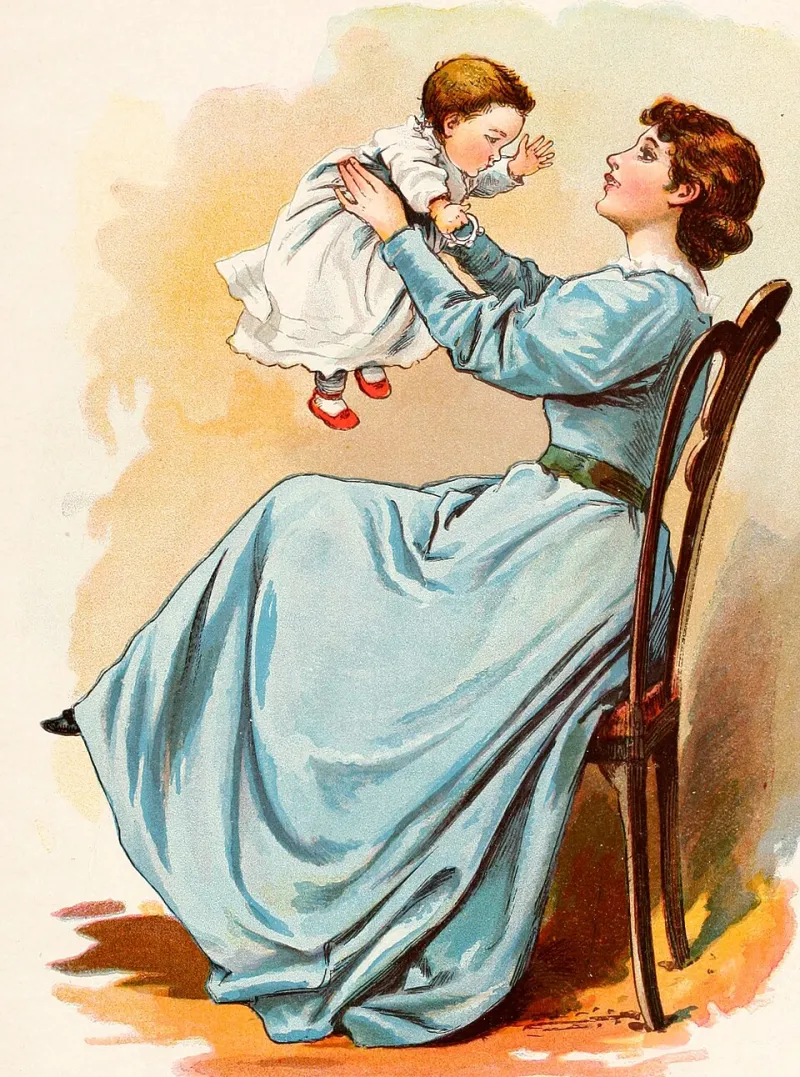
Photo: illustrator uncredited; publisher is https://freevintageillustrations.com/vintage-book-illustrations/gems-from-mother-goose, Public domain, via Wikimedia Commons
The box sat in my sister's garage in Ohio for three years after Mom died, wedged between a dehumidifier nobody used and a stack of holiday tins. We both kept walking past it. You know how it goes — the boxes that matter most are the ones you can't quite bring yourself to open.
When I finally did, I found the usual archaeology of a life: report cards, a funeral pamphlet, a crocheted doily still smelling faintly of that house on Maple Street. And underneath everything, wrapped in a pillowcase, was a baby book. Mine. The kind with a padded cover and a little foil frame on the front where a hospital photo of me, wrinkled and furious, had faded to almost nothing.
A Voice Made of Loops
Here's what nobody tells you about grief: it's not the big anniversaries that knock you over. It's the handwriting.
I'd forgotten my mother had beautiful penmanship. By the time I was old enough to notice such things, she'd switched to grocery-list shorthand and signature-only scribbles. But in this book, written in 1987 and 1988, her cursive was full of confident loops, the letters leaning slightly right like they were in a hurry to be read.
I sat on the garage floor and read every page. Not for the content — I could have gotten the content from anyone. "First word: dada. First tooth: bottom left, May 14." It was the voice I was after. And somehow, in the slant of her letters and the way she crossed her t's with a little flourish, I could hear it. The specific music of her. The way she'd say "my goodness" instead of swearing. The pauses she left before saying something tender.
Pen strokes are a strange kind of recording. No audio, no video, and yet — a voice.
The Mother I Didn't Know Was Keeping Notes
The surprises came in the margins.
Next to the standard entries — weight, feeding schedule, the pediatrician's name — she'd written small asides in pencil. "Slept through the night. I cried, honestly." Beside a photo of me in a pumpkin costume from Kmart: "She hated it. I loved it. Fair trade."
I never knew her to write like that. In my memory, she was practical to a fault, a woman who ordered the same turkey club at every restaurant in a forty-mile radius. But this baby book held a wit I didn't recognize, a self-deprecating humor, even a little poetry. On my first birthday she wrote: "One year of her. She's made me braver than I planned to be."
That stopped me cold. My mother, brave? She was the woman who wouldn't drive on the interstate. And yet there it was, in her own hand: a persona she never performed out loud, one that existed only on the page, for an audience of one — me, decades before I could read it.
What We're Really Saving When We Save Paper
After the funeral, my sister and I had one fight, and it was about the boxes. She wanted to sort, toss, and be done. I couldn't explain why I wanted to keep a diaper receipt from 1988. I still can't, fully.
But I think it's this: handwriting is the last analog thing we have left of a person. Emails can be printed but they don't lean right. Texts don't loop. A voice message gets deleted or lost to a dead phone. But ink on a page — that's a physical act. Her hand moved, and the evidence is still there, thirty-some years later, in a garage in Ohio.
If you've inherited a box like this — and so many of us have, sitting in basements from Sacramento to Scranton — here's my gentle push: open it. Not all at once. One folder at a time, with coffee, on a Saturday. Read the handwriting before you read the words. The words are information. The handwriting is the person.
Finishing Her Sentences
The last page of the baby book is blank. There was supposed to be more — school years, milestones, the whole arc the book's designers imagined. But she stopped at eighteen months, the way most parents do, when the living got busy.
I've thought about writing in it. Adding an entry in my own hand, telling her about the life she only saw the beginning of. It feels presumptuous and exactly right at the same time. Maybe that's what these inherited papers are for — not just reading the past, but continuing the correspondence.
For now, the book lives on my shelf in Illinois, next to the doily, which my cat has claimed as a bed. Some nights I take it down and just look at a single page, the way you'd look at a photograph. "She's made me braver than I planned to be."
Funny. I was about to write the same thing about her.