The Hardest Sentence I Ever Typed Instead of Said
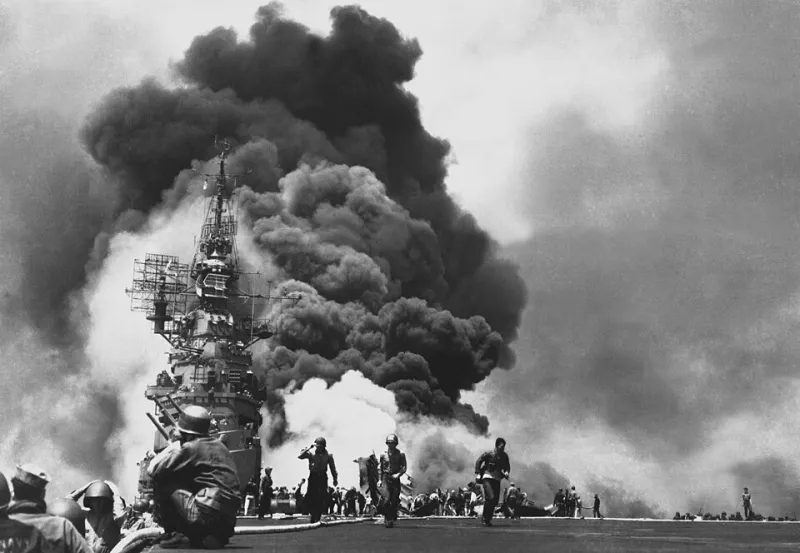
Photo: U.S. Navy; The original uploader was Quercusrobur at English Wikipedia.., Public domain, via Wikimedia Commons
It took me eleven minutes to type. I know because I watched the clock, deleting and retyping, softening a word here, sharpening one there. It was three sentences long. It ended a friendship I'd had since college.
I never said it out loud. I never heard her reaction — just the read receipt, then the typing bubble that appeared and vanished four times before she replied, "Wow. Okay."
That was two years ago, and I think about those eleven minutes more than I think about the fifteen years.
What the Screen Deletes
Here's what a screen takes out of a hard conversation: everything that makes it hard to be cruel, and everything that makes it possible to be forgiven.
When you say something difficult to someone's face, your voice shakes whether you want it to or not. Your eyes have to go somewhere. There's no draft folder. The words leave your body and become real in a shared room, and both people have to sit inside what just happened. That's the terror of it. That's also, I've come to believe, the entire point.
My mother's family settled disagreements at the kitchen table in Ohio — loudly, over pot roast, with someone always leaving to "check on something" in the garage and returning twenty minutes later having decided to stay married. Nobody enjoyed it. Everybody showed up.
The Council Meeting Nobody Watches
I went to a town council meeting in my small Michigan town last spring, mostly out of boredom. What I got was a masterclass.
A man got up during public comment to oppose a proposed fence near the elementary school. He and a councilwoman had clearly been feuding about this for months — you could smell the history. But he stood at the podium, in front of forty neighbors and a public-access camera, and made his case. His hands shook. She pushed back. He sat down. Afterwards, they talked by the coffee urn like two people who would be seeing each other at the hardware store on Saturday, because they would be.
Nobody left the meeting feeling great. But everyone left having been in the room where it happened. Nobody could retell the story however they wanted later. There were forty witnesses.
Compare that to the family group chat where my uncle announced, via text, that he wouldn't be coming to Thanksgiving, along with his reasons, which were aimed at my aunt. Forty-seven messages followed. Three people left the chat. My aunt called me crying, then texted him something she'd never say aloud, and he replied with a thumbs-up.
A thumbs-up. To his sister.
The Kitchen Rule
A line cook I know told me about the rule in restaurant kitchens: you don't send a problem. If there's an issue between stations, you walk over and you say it, face to face, fast, because the shift is too short for anything else. "The kitchen is the last place in America where you're forced to resolve things in real time," she said. "It's ugly. It works."
That's the part I keep circling back to. The screen didn't make us cowards. It made cowardice efficient. It let us skip the shaking voice, the eye contact, the irreversibility — all the parts of confrontation that are uncomfortable and, it turns out, load-bearing.
Because here's what those parts buy us: the other person gets to see that it costs us something to say. And we get to see their face when they hear it — the hurt, yes, but also the humanity that a typing bubble will never show us.
What I'd Do Differently
I don't regret ending the friendship. I regret the medium. I've drafted what I should have said a hundred times in my head: a phone call, or better, coffee — the neutral ground of breakup diplomacy. It would have taken courage I didn't have that night. The screen let me be brave in eleven-minute increments, with a delete key as a safety net.
Since then I've been running a quiet experiment. The hard things — the apology I owed my brother, the boundary I needed with a coworker, the voicemail to a friend who'd hurt me — I've been saying them with my actual mouth. Every single time has been worse in the moment and better in the aftermath. Every one.
We keep talking about how divided we are as a country, how nobody can talk to anybody anymore. I don't think it's that we've run out of things to say. I think we've run out of willingness to be seen saying them.
The screen promised us that hard conversations could be painless. It lied. It just made them silent — and silence, it turns out, is the most expensive thing two people can share.