She Has Your Same Eyes: Borrowed Faces and the Strangers Who Wear Them
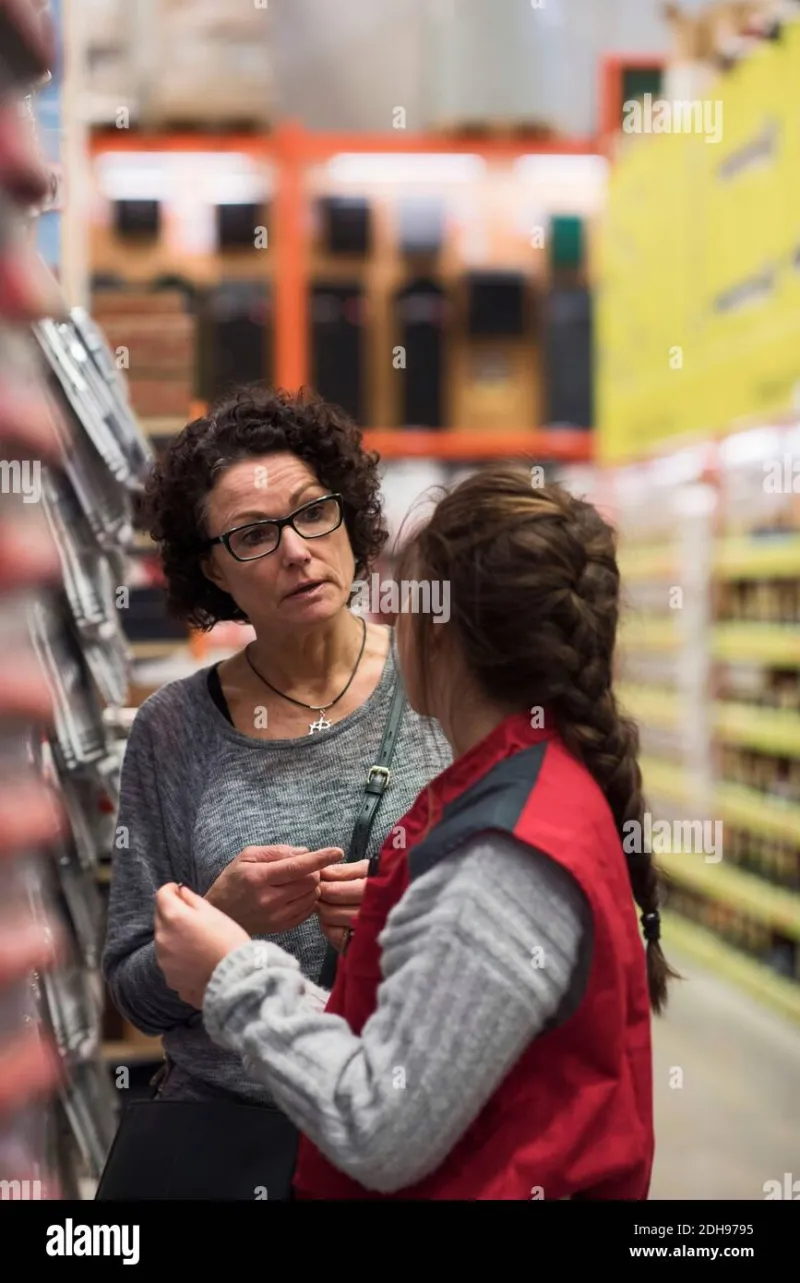
Photo: two women strangers talking in hardware store aisle, via c8.alamy.com
The woman at the hardware store grabbed my forearm before she said a word. We were both reaching for the same display of brass hinges, and instead of apologizing, she just stared. Then she said the thing strangers have been saying to me my whole life, in gas stations and funeral receptions and the checkout line at a Kroger in Dayton:
"You have my sister's eyes."
Her sister, it turned out, had died in 2019. The woman — Diane, she offered eventually, once she'd stopped blinking back tears in aisle six — wanted to know if I was from her hometown. I wasn't. I'd never been to her hometown. As far as I knew, I wasn't related to anyone named Diane or her late sister, whose name I now carry around like a small stone: Marlene.
The Face Isn't Yours Until Someone Claims It
Here's what nobody tells you about having a face: it's the most public thing you own and the least examined. You know your opinions, your shoe size, the way you take your coffee. Your face, though? That belongs to everyone else. They read it, rate it, and — if you're lucky or unlucky, I still haven't decided — map it onto people you've never met.
I've been told I look like a college roommate's aunt. A substitute teacher from my brother's middle school. A character actor who was in one episode of a procedural drama in 2004. None of these people are related to me, as far as genealogy and Ancestry.com can tell. And yet every time someone makes the connection, there's a flicker of recognition in their eyes that says, unmistakably: I know you.
Except they don't. And I don't know them. And still, something passes between us.
The Family Face, Arriving Unannounced
My grandmother used to say that our family face "skips around like a flea." She meant that certain features — the heavy brows, the crooked left smile — appear in relatives two and three generations apart, skipping parents entirely. My own father has a face nothing like mine. But my great-grandfather, dead in 1961, could apparently be my twin based on the single surviving photograph, the one where he's squinting outside a general store in rural Pennsylvania.
I never met him. He's been gone longer than I've been alive. But when my mother showed me that photo for the first time, I felt something I can only describe as being caught. Like I'd shown up somewhere wearing his coat.
Scientists have a term for strangers who share faces — doppelgängers — and there's real research behind it. Studies out of Europe have found that look-alike strangers with no shared ancestry often have similar DNA profiles and even similar habits. Which raises a question I keep turning over: if a stranger in Oregon and I share a face and a few genetic markers, who does the face belong to? Both of us? Neither?
Borrowed, Not Owned
A friend of mine, adopted as an infant, told me once that the hardest part of not knowing her birth parents wasn't the missing history — it was the missing mirror. "Every time someone said I looked like someone, it was a lie or a coincidence," she said. "I wanted one true resemblance. Just one."
She found her birth mother at thirty-four. The first thing she did, she admits, was stare at the woman's face for a full minute in a Denny's booth outside Tulsa. "I wasn't looking at her," she said. "I was looking for me."
Maybe that's what Diane was doing in the hardware store, too. Not seeing me — seeing Marlene, one more time, in the least likely place possible. Maybe every case of mistaken face is really a small act of grief or hope, a person reaching through a stranger toward someone they lost or never got to know.
What I Owe the People Who See Her
I could have brushed Diane off. A polite laugh, a "crazy coincidence," hinges purchased, exit made. Instead I stood there for twenty minutes and let her tell me about her sister — how Marlene laughed with her whole body, how she kept a garden that was more weeds than tomatoes and defended it fiercely, how her eyes crinkled in a way people always said was "distinctive," which apparently meant mine.
I don't know if any of it's true of my face. But I let her have it, because here's what I've come to believe: faces are less like property and more like public parks. We maintain them, we're responsible for them, but we don't get to control who walks through or what memories they trigger.
Marlene, wherever you are — I hope I did your eyes justice that day. I hope the woman in aisle six walked out feeling a little less alone. And I hope, someday, when a stranger grabs my arm and tells me I have somebody's smile, I remember that I'm not being confused with someone else.
I'm being used as a door. And honestly? There are worse things to be.