The Blue Glow on a Stranger's Cheek: What We Stop Seeing When the Theater Goes Dark and Empty
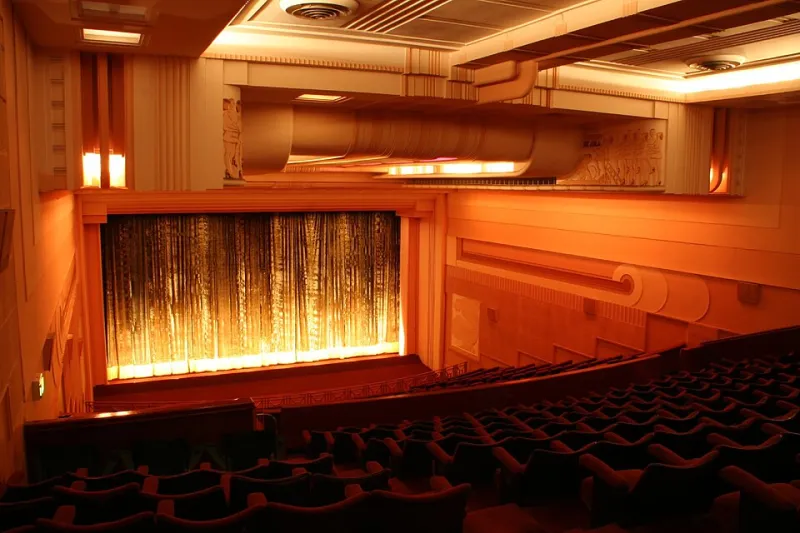
Photo: Rob Chandler, CC BY 2.0, via Wikimedia Commons
There's a specific kind of intimacy that only happens in the dark, between people who will never speak. I felt it again last spring at a revival screening of Jaws at a small independent theater outside Philadelphia. The room was packed — the kind of packed where you have to pull your elbows in when you sit down — and when that shark finally surfaced under poor Ben Gardner's boat, half the theater screamed.
The other half laughed at the screaming.
And I didn't look at the screen. I looked at the laughers.
The Second Screen We Forgot We Had
For most of the twentieth century, going to the movies meant going somewhere with people. Not beside them, not coincidentally near them — with them, in a way that was never negotiated and never named. You arrived as strangers, sat in rows like a temporary congregation, and for two hours you participated in something that felt suspiciously like communal emotion.
The screen was bright. The room was dark. And that combination did something quietly remarkable: it turned every face in the audience into a softly lit mirror of the film itself. A jump scare would wash the rows in white light and you'd catch, for a quarter of a second, thirty strangers flinching at once. A romantic ending would bathe the room in that warm, flickering amber, and you could see the woman two seats over wiping her eyes with the back of her hand, pretending it was an itch.
Nobody taught us how to read this. We just did. It was a language — the gasp that travels down a row of seats like a wave, the collective laugh that's funnier than the joke, the terrible, beautiful silence after a plot twist lands.
I didn't realize it was a language until it stopped being spoken.
What the Algorithm Never Shows You
Here's the thing about watching a movie alone on your couch: you still cry at the sad parts. You still jump at the loud ones. But you do it in a vacuum. There's no confirmation, no echo, no stranger's face telling you yes, that got me too.
Streaming sold us convenience and, quietly, took the audience. My living room is darker than any theater — the TV glow lands on nothing but me and the cat. The pause button means nobody else's experience can outpace mine. The algorithm means nobody chose this film at the same hour I did, out of the same restlessness or heartbreak or boredom.
And I've noticed something odd about myself: I miss the reactions more than I miss the popcorn, more than the sticky floors, more than the twenty minutes of previews. I miss reading faces.
Because that's what it was, underneath everything. The movies gave us a socially acceptable excuse to study other people — openly, for hours, without consequence. Where else in American life can you stare at strangers and call it entertainment? We are a culture that averts its eyes in elevators, that invented the phrase "watching too long." The theater was our one sanctioned exception.
A Brief Field Guide to the Audience
If you went to enough movies, you learned the cast of characters. Every packed theater had them:
The Laugher, who found things funny roughly four seconds before anyone else did, and whose laugh gave you permission to find them funny too.
The Commenter, who narrated softly to their date, and whose whispers became a second, unofficial commentary track.
The Crier, who sniffled through the third act while you pretended not to hear, and whose vulnerability quietly licensed your own.
The Leaver, who got up at the worst possible moment and became, briefly, a silhouette blocking the explosion you'd waited ninety minutes for.
You knew these people. You never learned their names. And when the lights came up, you'd shuffle past each other toward the exits, blinking like divers surfacing, back to being strangers.
But for two hours, you were a we.
The Empty Rows
I went to the multiplex on a Tuesday recently and counted the other people in my showing. Four. The theater was so empty that the screen's glow had nothing to land on — no cheeks, no flinches, no faces turned toward the light like sunflowers. The film played to a room that might as well have been my living room with better sound.
It was fine. It was convenient. It was nothing.
The name of this site, Chehrak, comes from a word for face — and the older I get, the more I think faces were the whole point. Not just the ones on the screen. The ones in the dark, catching the light, telling each other how to feel.
There's a revival house near me that still sells out on weekends. The last time I went, during the final scene of a film I won't spoil here, the entire room went completely still — and then, when the credits rolled, nobody moved. Two hundred strangers sat in the dark together for a full minute, not wanting to break whatever spell we were all inside of.
You can't pause that. You can't stream it. You can only be there, glowing in someone else's peripheral vision, part of the second screen nobody remembers they came for.